Archive for life

Jury Duty Fizzle

I left home this morning en route to San Diego’s downtown Hall of Justice. The night’s rain hadn’t clogged the cement arteries as expected, leaving me enough time to do my signature get-lost-everytime-I-go-downtown routine.

After some tired opening remarks, my fellow potential jurors and I waited for our names to be called. Two and a half hours later, I closed another losing game of Vegas-style three-card draw solitaire on the Treo, unplugged the shuffle’s earbud from my left ear, grabbed my $1.50 bottle of water, and made one last pit stop to blow my stuffiness into a paper towel before heading up to a courtroom.

Unfortunately, I wasn’t among the first 18 selected for questioning. I watched the process alongside the other spares. The lawyers didn’t dismiss enough people to give me my shot, so the rest of us went back into the jury pool for another run after lunch.

The post-lunch waiting room was thin enough to find a seat near the TV to watch CNN’s version of presidential race. Another hour later, an amplified female voice fell from the ceiling tiles, “The docket is now clear. You may all head home having completed your service. Thank you.” I stamped my receipt and let myself out, disappointed.

SENTRI: Privileged Border Crossing

Privileged Crossing
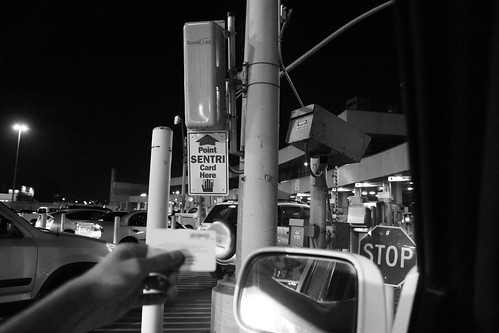
Before approaching the border agent in the SENTRI lane, the RFID card and windshield-mounted sensor show the agent a photo of who to expect. For many, there’s a bit of mystery surrounding the golden ticket we call the SENTRI pass. To get it, you have to submit your weight in paperwork — birth certificate, passport, social security card, drivers license, residence and employment history, vehicle docs (VIN, plates, registration, insurance), proof of residence, employment, pay stubs, bank statements, etc. They run a background check and laser-scan your fingerprints. It’s straight out of Gattaca.

[ view more images of border crossing | slideshow ]

Clothes Line vs Dryer

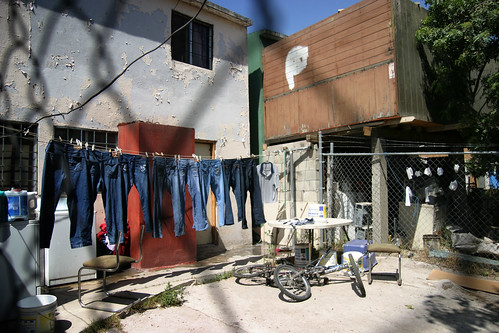
My clothes have been dried on a clothes line very few times in my life. For the first few months living in Tijuana (2004-2005), we didn’t have a drier. We pinned our wet clothes on orange and yellow plastic ropes, strung across the patio. Here, you can see our neighbors clothes line, including socks hung on the chain-linked fence:

Los Vecinos

My American patience level got the best of me and I bought a dryer. I’ve used dryers before. I grew up with a dryer. You press a button and clothes come out dry a few minutes later. Dry and wrinkled, that is. No matter what settings I use, I end up with wrinkled clothes. To this day, I haven’t mastered the magic combination of heat, load size and timing. Note the ironing board tucked next to the stacked washer/dryer (2007):

Goodbye Laundromat

On the surface, it may look like an upgrade, but I’m back to the drawing board with all new settings. It’s like microwaving popcorn without a popcorn button. Inconceivable. I’ve flirted with the idea of taking everything to the cleaners, but that seems like one step too far across the yuppie line. Maybe I’ll string up a clothes line across the new patio

Just imagine. You’re beaten silly in soapy water only to be tortured for another half-hour in a tumbling inferno. Or, you’re gently draped in the open air, kissed by the sun, the breeze whispering sweet nothings in your ear.

Line Dry

[ view more clothes line photos | slideshow ]

Saturdays in TJ: Politics, Haircuts & Soda

I slip on my untied shoes and open the door. It’s a cloudless Saturday morning in Tijuana. The clean blue sky beams the muffled sounds of a nearby loudspeaker. The community soccer court a few houses down the road is full of white tents and red-shirted organizers. It’s election time.

Colonia Solidaridad

I walk down the cement steps to the kitchen. “Quieres almorzar? Do you want breakfast?” my mother-in-law asks. “Si, gracias” I reply. Two eggs over-easy, cebollitas (sauteed onions), beans, corn tortillas and chile. “Estuvo muy rico como siempre, It was very good as always” I tell her. She takes my plate with a small but satisfied smile.

Leaning over the bathroom sink, I lift my t-shirt collar and dry my face. It’s been a week since I shaved. I pull a clean pair of socks from my bag to replace the ones I slept in. Shoes laced and camera bag on my shoulder, I head outside.

The streets are lined with cars. The mayor is on his way. The previous mayor, Jorge Hank Rhon, made a visit the year before to inaugurate the soccer court his government helped build.
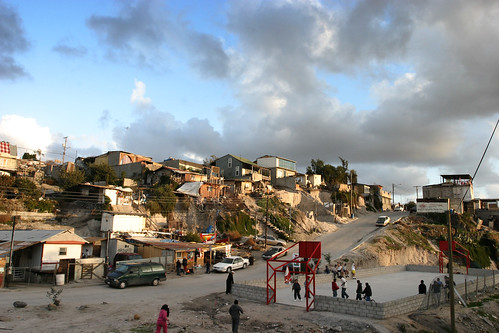
Cancha
View of the court in the early stages of construction, directly opposite the image above

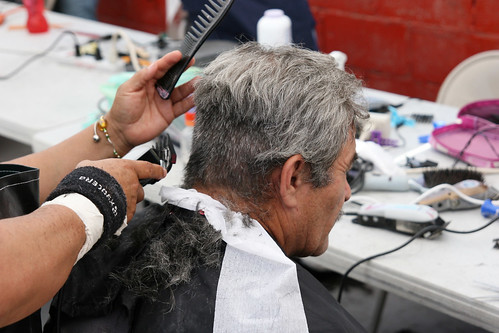
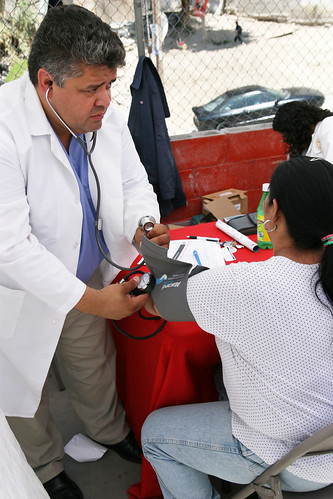
This morning, residents from the working-class neighborhood receive free haircuts, medical screenings, and groceries. A man plunges a syringe into the thigh of a small dog. He cries out from the sting of the free vaccine and hobbles away. A young girl scoops him up, cradling her wounded little friend. The amplified voices of the organizers raffle off food, plants and toys.
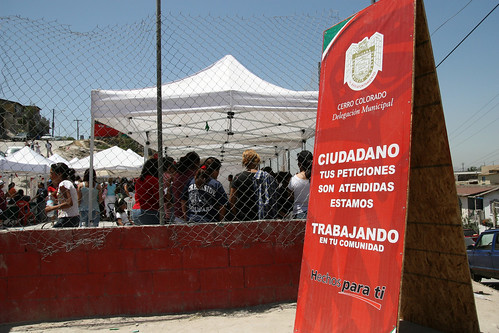
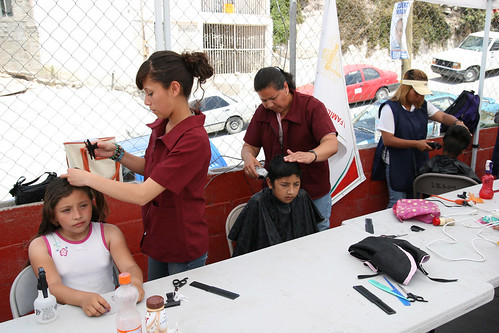
"Trabajando en Tu Comunidad"

Haircut 1

Haircut 3

Blood Pressure

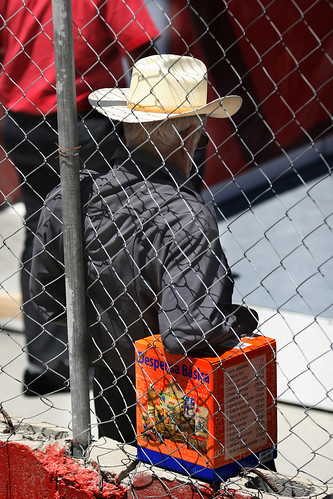
Despensa Básica

A girl approaches, maybe 20 years old, speaking to me through sunglasses. She asks who I’m with. “Vengo de la colonia para ver qué onda, I’m coming from the neighborhood, to see what’s up” I say, trying to downplay the fact that I’m clearly not from the neighborhood. She asks me who I work for, and I tell her. A public media organization in San Diego, visiting family nearby, thought I’d see what all the fuss is about. She tells me she’s a communication major. I give her one of the cards from my bag. “Estamos en contacto, We’ll be in touch,” she says walking away.
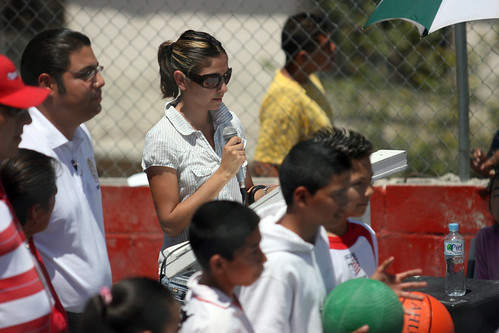
Communication Major

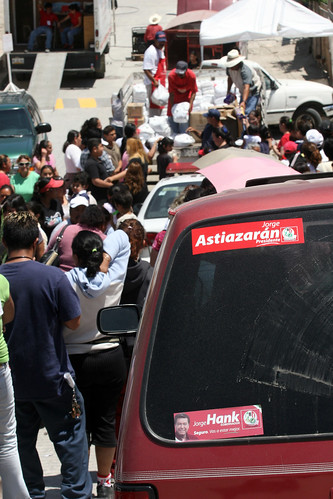
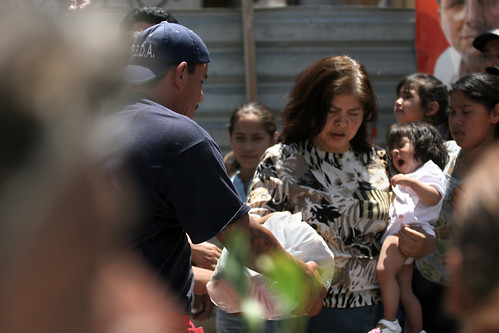
From the improvised stage, they inform the crowd that the mayor’s visit is cancelled. They explain that he had an urgent appointment with the governor and offers his sincerest apologies. But not without further adieu. They announce the distribution of the despensas, essential groceries, and diapers. The crowd exits the soccer court and forms a line at the back of a worn palette truck. Those at the back of the line urge those at the front not to mob the truck, “Respeta la fila! Respect the line!”
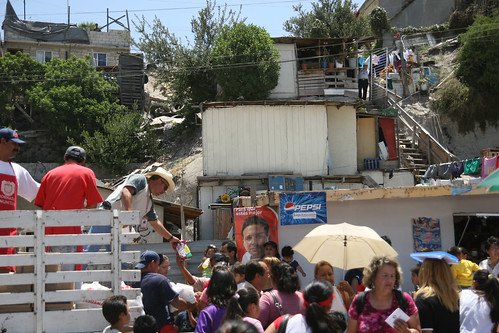
Man Overlooks Crowd

Handoff

Political Gesture

An hour later, the court is empty. The cars are gone. But the names of PRI party candidates Jorge Hank Rhon (running for governer of Baja California) and Jorge Aztiazarán (running for mayor of Tijuana) remain. Their signature red remains. The soccer court was strategically painted red. Hank had a large section of the border fence between San Ysidro and the beach painted red. The PRI is known for going into poor neighborhoods and giving free services. The people benefit from it. And so do the candidates.

Later that afternoon, my three nephews, my brother-in-law Fermin and I walk to the same red court for a game. They avoided the scene earlier, not wanting haircuts. “Lo cortan bien chueco, They cut it all crooked.”Fermin and I take opposite sides, and the boys split up. “Jugamos a soda, Loser buys soda.” After the game, they buy a two-liter of grapefruit Fresca and ask for 5 plastic bags. They fill the bags and pass them around. A quick twist to close the top and a tear out of the corner, it’s a refreshing victory.
The Sound of a New Year in Tijuana

The night sky in one of Tijuana’s neighborhoods explodes with energy in the early hours of 2007. My nephews and I share in the improvised community pyrotechnics to welcome the new year. The spirit of celebration emanates all around us.

icon for podpress  Podcast Video [4:51m]: Download

Holiday Border Traffic

Leaving the Tijuana airport as Sunday became Monday, Rosario and I stood in the cold air, waiting for the taxi. After a delayed return flight from Guanajuato, we prepared ourselves for what border traffic we might encounter. On a typical Sunday night at this hour, you can expect to cross in an hour or less. But this was the Sunday end to Thanksgiving weekend. And anytime there’s a U.S. holiday, border traffic is exponential.

The taxi drops us at Rosario’s sister’s home, where the trusty Nissan Frontier waits. We transfer luggage to the truck and head like zombies for the Otay crossing. When we arrive at 1:30 a.m., there are only two short, thin lines. “Mira, it’s not so bad,” I say to a reclined Rosario. I undo my seatbelt and make myself comfortable for what should take 30 to 40 minutes. At this hour, the customs agents typically work slower than normal, but after 45 minutes and only advancing 10 cars, I start having my doubts. Cars continue to gather in other rows, to the point that I no longer have an exit option. After asking a passing window washer, and seeing cars turn and head back, my half-conscious mind realizes the lanes are closed. No one is getting through.

I see a brief opening between cars and shove my way into the outside lane, making an overdue escape. Too tired to be outwardly angry, I take my grumpiness to San Ysidro to give it another shot. Otay is supposed to be open 24 hours, but because it’s a secondary entry point, it can be less consistent. We arrive at San Ysidro to much longer lines full of sleeping cars, lights and engines off. “Let’s just go to a hotel to sleep,” Rosario offers. But I’m not in the mood. I want to sleep in my bed tonight even if it’s just for a few hours. “Let’s just sleep in the SENTRI lane. It opens in a couple hours,” I decide.

It’s now 3 a.m. as we pull alongside one other car already waiting in the lane. I put it in park, turn off the engine, and pull out the laptop to play solitaire. I hit a second wind, now unable to sleep. After a half-hour losing repeatedly at the Vegas-style three-card game, I take out the camera.

Waiting for the SENTRI lanes to open

Lanes Closed

At 4 a.m., the lane opens and we cross the line. The final leg of the drowsy marathon came to a close another half-hour later, and sleep came soon thereafter. As a privileged member of the SENTRI program, my heart goes out to all of my compas who were already beginning their workweek as I recoup a few hours sleep under the high thread-count sheets and synthetic down comforter of my king-sized bed.